In short
Foreign buyers decide whether to contact you before they ever fill in a form. Here is the checklist we run on a manufacturer's site, so you can run it on yours.
Before a procurement team abroad sends a request for quotation (RFQ), they have usually spent some time on your website with no contact at all. They are not browsing for fun. They are checking whether you can make what they need, to the standard they need, and whether you are a real factory that will still answer the phone after the deposit is paid. Most of that judgement happens before anyone fills in a form.
Below is the checklist we use when we look at a manufacturer's site with export buyers in mind. You can run it yourself in an afternoon. Open your site on a laptop and on a phone, pretend you are a buyer in another country who has never heard of you, and tick each check honestly.
1. Can a buyer compare your products without opening a PDF?
A buyer shortlisting suppliers wants to compare models side by side: size, material, standard, capacity, finish. If every product's specs sit in a separate PDF, the comparison happens in their downloads folder, not on your site, and many will not bother.
- Check: pick two products from the same family. Are their specs on the page, as text, in the same table with the same rows in the same order?
- Check: is there still a downloadable spec sheet for each product, for the buyer who needs to file it or send it to an engineer?
- Check: can a buyer filter or browse by the thing they actually search by, such as size, standard or application, and not only by your internal product names?
Both matter: the table on the page for comparing, the file for the paperwork. When we built the catalogue for Bioden Gübre, a fertiliser maker, each of its 13 products shows its guaranteed content in the same table, from organic matter and total nitrogen to pH and moisture, so a dealer can compare formulas side by side. The team adds a new formula in the admin and it appears in the catalogue and category pages without a new page being built.
2. Are your certificates public, current and one click away?
Procurement teams check a supplier's credentials early, often before they talk to you. If they have to email to ask for your ISO 9001 certificate, you have added a day and a reason to move on to the next supplier.
- Check: are your management system certificates (ISO 9001 for quality, ISO 14001 for environment, ISO 45001 for health and safety, and any others you hold) downloadable without asking?
- Check: open each file. Is it the current certificate, or one that expired last year? An expired PDF is worse than none.
- Check: if your product needs CE marking to be sold in the EU, or a product registration in your home market, is the relevant document linked from the product page itself, where the buyer is looking?
- Check: can someone on your team replace an expired certificate without calling a developer?
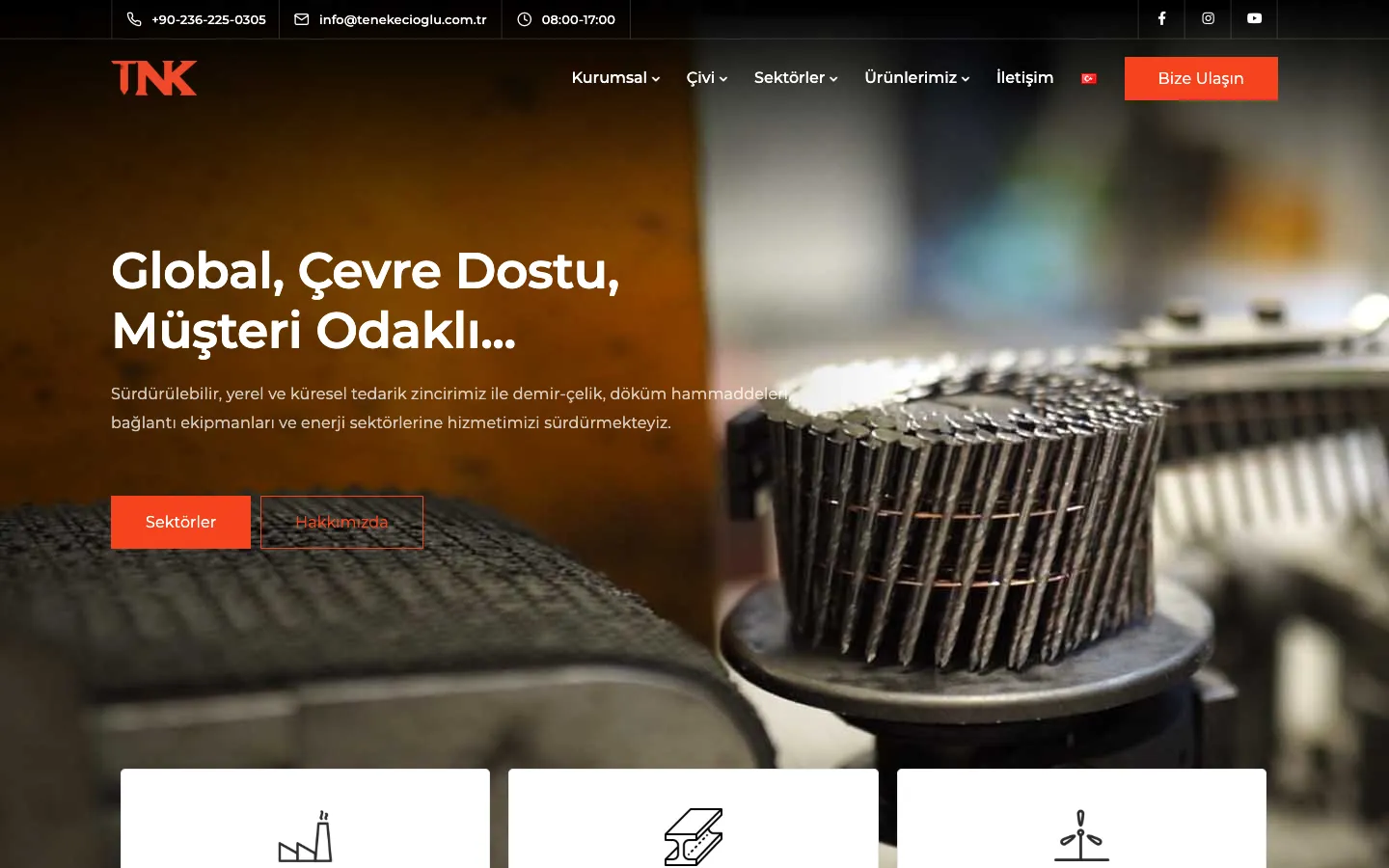
For Tenekecioğlu (TNK), a nail factory that exports mainly to the US, the corporate page links its ISO 9001, ISO 14001, ISO 45001 and ISO 10002 certificates as PDFs, next to its published policies. The team can update certificates themselves. Bioden's product pages each link to the product's registration certificate.
3. Does the site say how you sell, not only what you make?
A buyer needs three commercial facts before a price is even useful: the minimum order quantity (MOQ), the lead time, and the delivery terms. Delivery terms are usually expressed as an Incoterm, a standard three-letter code published by the International Chamber of Commerce (EXW, FOB, CIF, DAP and so on) that says who pays for and carries the risk of each leg of the shipment.
- Check: does each product family say its MOQ, or at least how MOQ is set (per size, per pallet, per container)?
- Check: is there a typical lead time, even as a range, and does it say what it depends on?
- Check: does the site say which Incoterms you usually quote, and from which port or factory?
- Check: packaging and shipping units: cartons, pallets, containers. A buyer planning a container needs to know how much fits.
You do not have to publish prices. Many manufacturers rightly keep a person on the final price for anything sized, certified or shipped abroad. But if the buyer cannot tell whether your MOQ is one pallet or ten containers, they cannot tell whether to write to you at all.
4. Is it in their language, and is that version up to date?
Many export buyers read English well enough to buy. Plenty prefer their own language, and a spec table in it removes doubt. The common failure is not missing languages but out-of-date ones: the home-language site gets new products, and the English or German version stays a year behind.
- Check: switch language on a product page. Do you land on the same product, or back on the home page?
- Check: count the products in each language. Do the numbers match?
- Check: are the spec fields themselves translated, or only the marketing text around them?
- Check (for your developer): does each page carry hreflang tags, the markup that tells search engines which language a page is in and which pages are translations of each other?
The fix is structural: run every language on one site with the same products and translated fields, so a new product reaches every language at the same time. Bioden's Turkish and English versions and TNK's Turkish and English versions both run this way, with hreflang tags on each page.
5. Does the quote form ask what your sales team needs?
A buyer who has got this far wants to send a request. If the only option is a generic contact form with name, email and message, the request arrives without quantity, material, standard or delivery country, and your sales team spends the next day writing back to ask.
- Check: is there a quote button on every product page, and does the request know which product it came from?
- Check: does the form ask, per product line, for the facts you price from: size or model, material, quantity, standard, delivery country, Incoterm and required date?
- Check: can the buyer attach a drawing, a spec sheet or a photo of the part they use today?
- Check: does the buyer get a confirmation with a reference number?
- Check: send a test request from your phone, in each language. Did it arrive, and in what shape?
On TNK's site, every product page ends with a quote request block, and an inquiry form opens in a pop-up on every page, so a visitor never has to hunt for a way to get in touch. If your form is the weak point, we have written up the details of quote forms that ask what sales needs.
6. Is there proof that the factory is real?
Buyers are wary of trading companies posing as factories, and of factories that turn out to be one rented unit. A website cannot prove everything, but it can remove the obvious doubts.
- Check: is the factory address on the site, with a map, and does it match your certificates and your company registration?
- Check: are there real photos of your production lines, warehouse and lab, not stock images of someone else's factory?
- Check: does the site explain what you make in-house and what you trade or source? Be clear about it. TNK makes nails and also trades steel raw materials; its navigation splits the site by business line so a nail buyer and a steel buyer each reach their section in one click.
- Check: are company policies (quality, environment, health and safety, data protection) published where a supplier audit would look for them?
- Check: does the site tell the story of how the product is made? Bioden's homepages walk through each step, from the biogas plant to compost to fertiliser, and link to the R&D lab and the agricultural policy pages.
7. Does it all still work next month?
Catalogues decay quietly. A product line is discontinued but still listed. A certificate expires. A plugin update breaks the form and nobody notices for three weeks because no RFQs come in, which looks like a slow month.
- Check: who on your team can add a product, change a spec field or replace a certificate today, without waiting for an agency?
- Check: is someone testing the quote form after every update?
- Check: when did anyone last open the site in each language and click through a product?
How to read your score
If you ticked most of sections 1 to 3, buyers can shortlist you. If sections 4 and 5 are weak, they shortlist you and then struggle to ask for a price. Section 6 is the one that loses you the buyers you never hear from: they look, they doubt, they close the tab.
Start with the cheapest fixes. Replacing expired certificates, adding MOQ and lead time text, and publishing the factory address cost almost nothing. A consistent spec table per product family and a proper quote form are bigger jobs, but they are usually a restructure of the site you have, not a rebuild. Both of the catalogues mentioned here run on WordPress, and the teams edit them in the admin.
If you would rather have someone go through it with you, this is the work we do: an export product catalogue with one spec table per product family, certificates on the product pages, every language on one site and a quote button on every product. We quote it at a fixed price before any work starts, and the same engineers keep it current afterwards.
FAQ
Frequently asked questions
Tagged